
Author: Department of Mechanical Engineering
Introduction
There is a widespread misconception among many students today that traditional engineering disciplines are losing relevance in an era dominated by software development, artificial intelligence, and digital technologies. As conversations increasingly focus on IT careers and coding-related roles, some students wonder whether core engineering fields still offer strong career opportunities.
The reality is quite different. Mechanical engineering continues to be one of the most important and versatile engineering disciplines, playing a critical role in industrial innovation, sustainable development, advanced manufacturing, transportation, and infrastructure. Far from declining, the field has evolved significantly to meet the demands of a rapidly changing technological landscape.
Modern mechanical engineers are no longer confined to designing machine components or working solely on manufacturing processes. They are contributing to electric mobility, renewable energy systems, robotics, automation, aerospace technologies, and smart industrial infrastructure. Rather than focusing only on traditional engineering practices, today’s mechanical engineers operate at the intersection of physical systems, digital technologies, and sustainability.
A closer examination of industry trends and sector-wise growth patterns clearly demonstrates why mechanical engineering remains a valuable and future-ready career choice in 2026.
The Job Market Outlook for Mechanical Engineers
Global industries are undergoing major transformations driven by technological advancement, sustainability goals, automation, and infrastructure development. These shifts are creating significant demand for engineers with strong technical and problem-solving capabilities.
According to recent industrial employment forecasts, demand for mechanical engineering professionals continues to grow steadily across multiple sectors. Large-scale investments in manufacturing modernisation, energy transition projects, transportation systems, and industrial automation are generating substantial employment opportunities worldwide.
As industries adopt increasingly sophisticated technologies, organisations are seeking engineers who can design, optimise, and maintain complex physical systems. This demand has created favourable employment conditions for graduates entering the workforce and for professionals seeking specialised career paths.
Sector-Wise Growth: Where the Opportunities Are Emerging
While mechanical engineering has traditionally been associated with manufacturing, today’s employment growth is concentrated in several rapidly expanding sectors.
Electric Mobility and Automotive Innovation
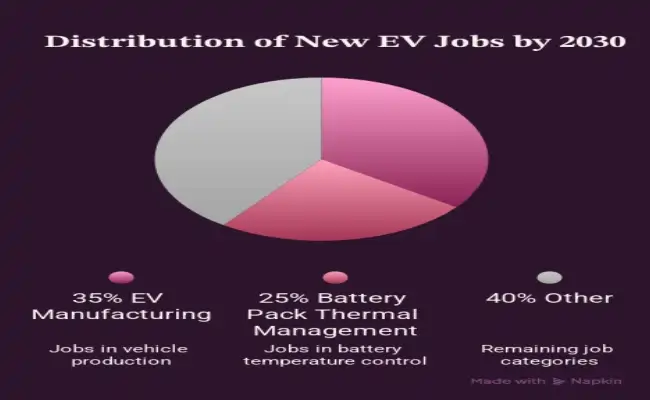
The automotive industry is currently experiencing one of the most significant transformations in its history. The rapid adoption of electric vehicles (EVs) is driving demand for engineers skilled in battery technologies, thermal management systems, vehicle dynamics, powertrain optimisation, and advanced manufacturing processes.
In emerging automotive markets such as India, EV adoption continues to accelerate, supported by government initiatives, sustainability goals, and growing consumer acceptance. This transition is expected to generate substantial employment opportunities across vehicle design, battery manufacturing, charging infrastructure development, and production engineering.
Mechanical engineers are playing a central role in designing safer, more efficient, and more sustainable transportation systems for the future.
Suggested Caption for Figure:
Projected Distribution of Employment Opportunities in the Electric Vehicle Ecosystem by 2030
Renewable Energy and Sustainable Infrastructure
As countries pursue ambitious net-zero and carbon reduction targets, renewable energy projects are expanding rapidly across the globe.
Mechanical engineers are increasingly involved in:
- Wind energy systems
- Solar thermal power plants
- Energy-efficient HVAC systems
- Industrial energy optimisation
- Sustainable building technologies
These areas require expertise in thermodynamics, fluid mechanics, heat transfer, and system design. Consequently, professionals with specialised knowledge in energy systems are witnessing strong demand and competitive compensation growth.
The global shift towards clean energy is expected to remain a major source of engineering employment for decades to come.
Robotics and Industrial Automation
Manufacturing facilities are embracing automation at an unprecedented pace to improve productivity, efficiency, and operational reliability.
This has created significant opportunities in robotics and automation engineering, where mechanical engineers collaborate with electrical engineers and software developers to design intelligent industrial systems.
Key areas of growth include:
- Industrial robotics
- Automated production systems
- Smart manufacturing
- Sensor-integrated machinery
- Mechatronic systems
The ability to combine mechanical design expertise with digital control systems has become particularly valuable in modern industrial environments.
Aerospace and Defence
The aerospace sector continues to experience substantial growth due to increasing investments in commercial aviation, defence manufacturing, satellite technology, and private space exploration initiatives.
Mechanical engineers specialising in areas such as:
- Structural analysis
- Propulsion systems
- Aerodynamics
- Materials engineering
- Thermal management
are finding opportunities in both public and private sector organisations.
Growing government investment and increased participation by private aerospace companies are expected to sustain demand for highly skilled mechanical engineering professionals throughout the coming decade.
Suggested Caption for Figure:
Industrial Sectors Showing the Highest Growth Potential for Mechanical Engineers
Industry Overview: Key Growth Areas
A review of current industry trends highlights several sectors where mechanical engineers are expected to remain highly sought after:
| Industry Sector | Key Growth Drivers | Employment Outlook |
|---|---|---|
| Electric Mobility (EV) | Battery systems, thermal management, vehicle design | Strong long-term growth driven by transportation electrification |
| Robotics & Automation | Smart factories, industrial robotics, automated production | High demand across manufacturing and industrial sectors |
| Renewable Energy & HVAC | Clean energy systems, energy efficiency, sustainable infrastructure | Expanding opportunities supported by global sustainability goals |
| Aerospace & Defence | Space technologies, aircraft systems, defence manufacturing | Strong growth supported by public and private investment |
These sectors collectively demonstrate the broad applicability of mechanical engineering skills across emerging industries.
Why Mechanical Engineering Remains Future-Proof
One of the greatest strengths of mechanical engineering is its adaptability. The discipline provides a solid foundation in mathematics, physics, design principles, materials science, and systems engineering. These core competencies remain essential regardless of technological changes.
As Industry 4.0 technologies continue to reshape industrial operations, mechanical engineers are increasingly expected to work alongside artificial intelligence systems, digital twins, simulation platforms, and advanced automation tools.
This integration of traditional engineering knowledge with modern technologies is creating a new generation of professionals capable of solving complex real-world challenges.
Conclusion
Students considering mechanical engineering should not be discouraged by the prominence of software-related careers. While digital technologies are transforming industries, the physical world still depends on engineers who can design, build, optimise, and maintain the machines, systems, and infrastructure that drive economic growth.
The evidence from emerging sectors such as electric mobility, renewable energy, robotics, automation, aerospace, and defence demonstrates that demand for mechanical engineering expertise remains strong and continues to evolve.
The future belongs to professionals who can combine foundational engineering principles with modern technological innovation. For students seeking a dynamic, impactful, and future-oriented career, mechanical engineering remains an excellent choice in 2026 and beyond.